What to Do During a Flood: The Complete Guide
When a flood is actively occurring, every decision you make carries real consequences. The homeowners who come through floods with minor damage — or escape without injury — didn't improvise. They executed a plan they had rehearsed in their heads before water ever appeared. This guide gives you that plan.
Flood response is divided into three decision points: the moment a warning is issued (before water arrives), when water first appears at your property, and when water is actively rising. Each phase demands different actions. Knowing which phase you're in prevents the hesitation that kills.
Phase 1: When a Flood Warning Is Issued (Minutes to Hours Before Water)
A Flood Warning — not a Watch, a Warning — means flooding is occurring or about to occur. You have a window of action that may close quickly. Use it in this order:
Step 1: Account for Everyone in Your Household
- Confirm the location of every family member — at school, at work, en route
- If children are at school, do not leave to pick them up unless you're certain roads are safe — schools have shelter-in-place protocols
- Call out-of-area family contact to report your status
Step 2: Move to Your Evacuation Decision Point
Check your FEMA flood zone and local emergency management guidance. If your area is under a mandatory evacuation order, leave immediately. Every minute of delay increases road risk.
If you're sheltering in place (not under a mandatory order), move to this phase:
Step 3: Deploy Your Flood Barriers
If you have flood barriers for doors, garage openings, or basement windows, deploy them now — before water reaches the entry points. Water-activated barriers and door shields work best when installed dry. See our guide to flood barriers for doors for placement guidance.
Step 4: Utilities
The sequence matters:
- Turn off gas at the meter if you smell gas or if water is expected to reach the meter. Do not attempt this if you must wade through water to reach it.
- Turn off electricity at the main breaker if water is expected to reach electrical outlets or your panel. Do not touch any electrical equipment while standing in water.
- Do not turn off water unless directed by local authorities — you may need it for sanitation.
Critical rule: Never touch electrical equipment, outlets, or cords if you're standing in or near water. Electrical current travels through floodwater. Electrocution is a significant cause of flood-related deaths.
Step 5: Move Valuables
Prioritize in this order:
- Critical documents — insurance policies, IDs, deeds (ideally in a waterproof bag)
- Irreplaceable items — family photos, hard drives with backups
- Medications and medical equipment
- Electronics — laptops, tablets, important devices
- Move furniture off floors if time permits — upholstered items absorb water and must be replaced; hard items on counters survive
Phase 2: Water Has Reached Your Property
When water is visible on your property — in your yard, at your foundation, or approaching your door — the action window has shortened significantly.
Sheltering in Place: Upper Floors
If you've decided to shelter in place, move everything to the highest floor of your home:
- Emergency kit (water, food, first aid, flashlights, battery radio)
- Warm clothing and blankets — flood conditions can drop temperatures dramatically
- Medications for all household members
- Cell phone charger and portable battery pack
- Pet food and carriers for pets
A battery-powered or hand-crank weather radio is essential when cell networks become overwhelmed — they typically do during major flood events. Invest in one before you need it: view emergency weather radios.
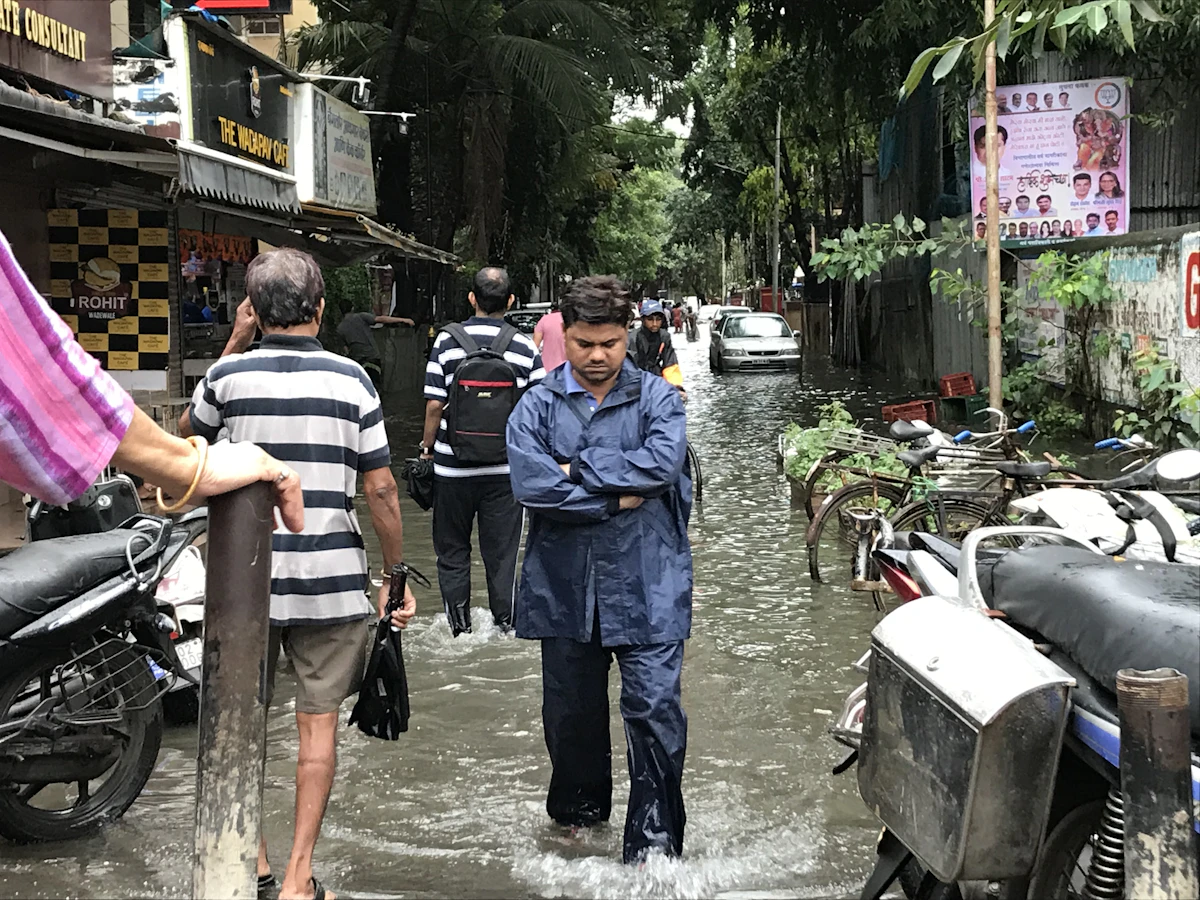
Never Wade Through Unknown Floodwater
This cannot be overstated. Floodwater is not clean water. It contains:
- Sewage: Municipal sewer systems overflow into floodwater within hours of a major event
- Chemical contamination: Gasoline, fertilizers, cleaning products, and industrial chemicals from flooded properties, vehicles, and facilities
- Hidden hazards: Open manholes, debris, downed power lines — all invisible under murky water
- Electrical current: Downed power lines energize floodwater for large areas around the contact point
If you must enter floodwater to reach safety, wear rubber-soled boots (not sandals), use a stick to probe the ground ahead, and avoid all moving water. Never enter moving floodwater on foot.
Evacuating During Active Flooding
If you must evacuate after water has begun rising:
- Use your pre-planned evacuation route — if roads are flooded, use your alternate route
- Never drive into water of unknown depth — see our guide on driving through flooded roads
- If roads are impassable, do not attempt to walk through standing water — return to your home and move to an upper floor
- If the situation becomes life-threatening, move to the roof and signal for rescue
- Call 911 and stay on the line — rescuers need your exact location
Phase 3: Water Is Actively Rising Inside Your Home
If water has entered your home and is rising, you've passed the shelter-in-place decision point. Now the priority is absolute personal safety — nothing else.
| Water Level | Immediate Action | Notes |
|---|---|---|
| Entering at doors / below ankle | Deploy barriers, move to upper floors | Barriers may still slow entry |
| Ankle to knee depth inside | Move to upper floors immediately | Do not collect belongings |
| Knee to waist depth inside | Upper floor / roof — call 911 | Current this depth is life-threatening |
| Waist or above | Roof — signal for rescue | Do not attempt to swim to safety |
Roof Signaling for Rescue
If you're on the roof awaiting rescue:
- Stay visible — use brightly colored clothing, reflective material, or flashlights
- Wave fabric or objects that contrast with your background
- Conserve phone battery — send your location, then reduce non-emergency use
- Stay calm — rescue teams prioritize active calls with confirmed locations
During a Flood: Communication Protocol
Telephone networks and cell towers frequently fail during major flood events due to power outages, physical damage, or overload. Prepare a communication plan in advance:
- Designate an out-of-area contact that all family members call or text — local networks fail when everyone calls locally simultaneously
- Text rather than call — texts require far less network bandwidth and often go through when voice calls fail
- Know your local emergency broadcast frequency for battery-powered radios
- Download your local emergency management app before an event — apps often work longer than voice calls
What Not to Do During a Flood
Equally important as what to do:
- Do not return to a flooded home until authorities declare it safe — structural damage, gas leaks, and electrical hazards may not be visible
- Do not touch flood-contaminated items with bare hands — use gloves for all cleanup
- Do not use generators, camp stoves, or grills indoors — carbon monoxide poisoning kills more people in the aftermath of floods than during them
- Do not drink tap water until your water authority declares it safe — flood events frequently contaminate municipal water supplies
- Do not wade in any standing water after the flood — downed power lines may still be energized
Protecting Pets During a Flood
Pets are often the last consideration and the first casualty. Plan for them explicitly:
- Know which emergency shelters in your area accept pets — most do not
- Identify a pet-friendly hotel, kennel, or contact outside your flood zone
- Keep a carrier accessible — a panicked pet can be impossible to load during an emergency
- Include 3 days of pet food and water in your emergency kit
- Tag and microchip your pets — flood separations are common and reunifications depend on identification
For deeper preparation, read our complete Flood Emergency Action Plan covering before, during, and after a flood. For your physical preparedness supplies, browse FloodReady's vetted flood protection products. A waterproof emergency bag costs $25–40 and can protect your critical documents through any flood event: view waterproof dry bags.
The families who come through floods intact are the ones who ran through this protocol mentally before water was anywhere near their door. Five minutes of mental rehearsal today could make a critical difference in an emergency.