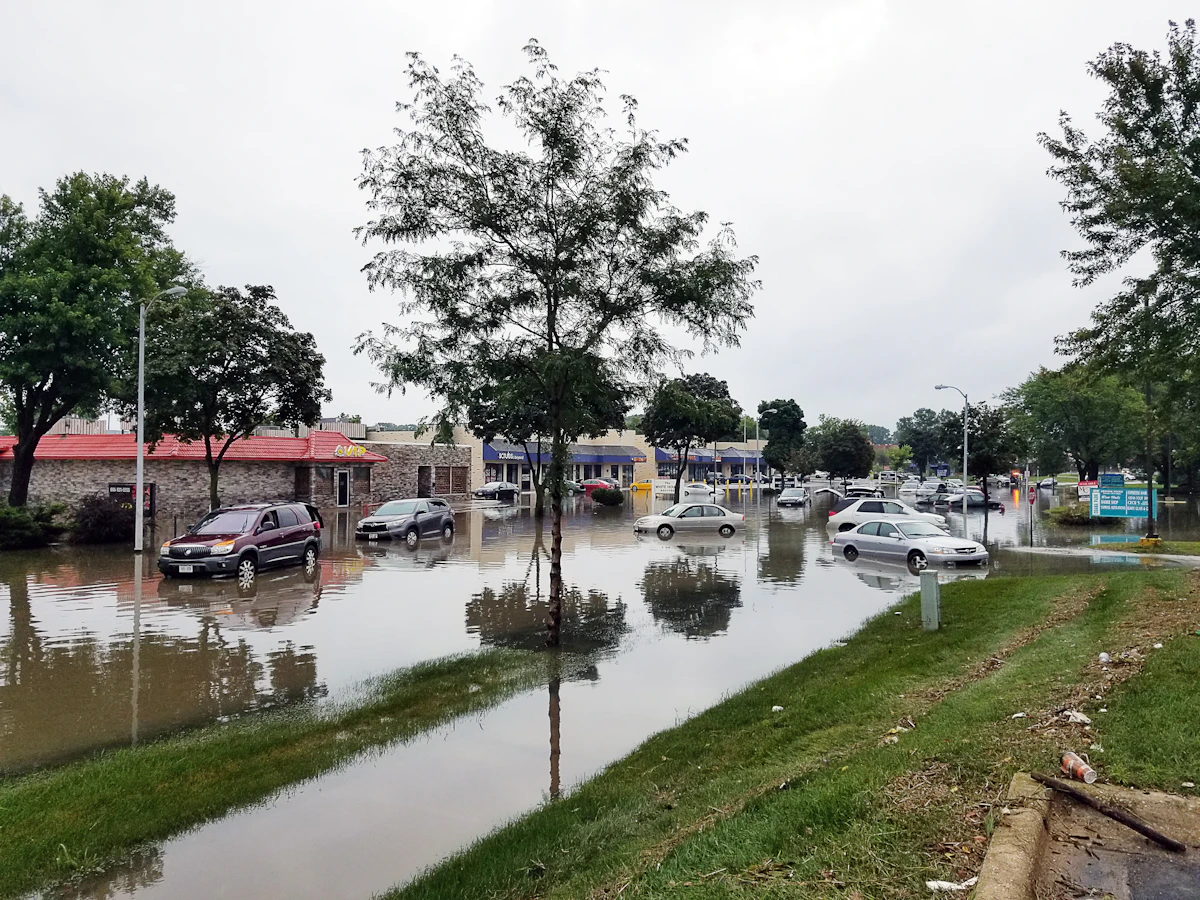
Is It Safe to Drive Through Flooded Roads?
No. This is not a nuanced answer. The National Weather Service, FEMA, and every emergency management agency in the United States have a unified position: Turn Around, Don't Drown. Driving into floodwater kills over 100 Americans every year — and the majority of those deaths involve depths that drivers judged "passable." They were wrong.
Understanding why floodwater is so dangerous even at seemingly shallow depths — and knowing exactly what to do if you're caught in rising water — can save your life.
The Physics of a Vehicle in Floodwater
Most people dramatically underestimate the force water exerts on a vehicle. The math is unambiguous:
Buoyancy
A standard passenger vehicle weighs approximately 3,000–4,500 lbs. Water weighs 62.4 lbs per cubic foot. When floodwater reaches the bottom of a car's doors — typically at 1.5–2 feet of depth — the upward buoyancy force exceeds the downward weight of the vehicle for most car models. The car begins to float.
A floating car is no longer in contact with the road. It has no traction, no steering effectiveness, and no braking. It becomes a raft at the mercy of the current.
Lateral Force
Moving floodwater at 1 foot deep traveling at 6 mph exerts approximately 1,000 lbs of lateral force on a full-size sedan. Road-width flood flows can move at 10–20 mph during a flash flood. At those speeds, the lateral force exceeds 3,000–5,000 lbs — more than enough to push a vehicle off a road, into a ditch, or over a bridge edge.
Depth Uncertainty
You cannot judge flood depth from a vehicle. Roads have variable surfaces, potholes, pavement edges, and drop-offs. A road that appears uniformly shallow at 6 inches may have a washed-out section at 4 feet just 10 feet ahead. Dozens of flood fatalities every year involve this exact scenario — the driver could see most of the road, but not the section that killed them.
How Much Water Does It Take?
| Water Depth | Effect on Vehicle | Risk Level |
|---|---|---|
| 2–4 inches | Hydroplaning risk; loss of traction begins | Moderate — reduce speed significantly |
| 6 inches | Reaches vehicle undercarriage; can cause loss of control; sweeps pedestrians off their feet | High — avoid if any current present |
| 12 inches (1 foot) | Stalls most passenger vehicles; lateral force reaches 1,000+ lbs in any current | Extreme — turn around |
| 18–24 inches (2 feet) | Floats most cars and SUVs; complete loss of steering and braking | Fatal — do not enter |
| 3+ feet | Sweeps all vehicles including large trucks and SUVs | Fatal — do not enter |
The NWS's "Turn Around Don't Drown" threshold is any flowing water on a roadway. That is the standard. Not "deep" water. Any moving water on a road surface is a turn-around trigger.
Why Drivers Still Drive Through Floodwater
Understanding why this mistake occurs helps prevent it:
- Familiarity bias: "I've driven this road 10,000 times." That history is meaningless. Flood conditions transform familiar roads in minutes.
- Depth underestimation: Water on a road appears shallow from inside a dry vehicle. The perspective provides no accurate depth cue.
- Social proof: Seeing another vehicle attempt the crossing feels like evidence it's passable. That vehicle may have been lighter, or may not have made it.
- Time pressure: The urgency to get home, get to family, or get to work creates decision-making that overrides risk judgment. Schedule-based urgency has no relevance to flood physics.
- Overconfidence in vehicle: SUVs and trucks do sit higher — but the physics of buoyancy and lateral force still apply. Larger vehicles are swept away at greater depths, but they are still swept away.
"Road Closed" Signs: What They Actually Mean
In flood conditions, "Road Closed" barricades are placed by emergency management personnel who have assessed the specific hazard. Driving around a barrier is:
- Illegal in every U.S. state — fines of $500–$1,000 are common; costs of rescue operations can be billed to the driver in many jurisdictions
- A leading cause of flood fatalities — FEMA data shows a significant percentage of vehicle flood deaths occur around "Road Closed" signs
- A burden on rescue personnel who must then divert to save the vehicle's occupants
The barricade was placed because someone with direct knowledge of the hazard determined it is not safe. That assessment supersedes any individual driver's judgment from inside a dry vehicle 100 yards away.
Safe Alternatives When Your Route Is Flooded
When your planned route is impassable:
- Turn around on dry pavement — never attempt a U-turn in or near floodwater
- Check alternate routes using navigation apps with real-time traffic (Google Maps, Waze) — many update flood closures in real time
- Wait it out — find a parking area on high ground and wait for water to recede and roads to be declared safe. Flood events typically pass within 4–12 hours.
- Contact family or emergency services if stranded — do not attempt to self-rescue through floodwater
If You Are Caught in Rising Water While Driving
Despite all preparation, circumstances sometimes trap drivers in rising water. The sequence of actions is:
- Stop immediately — do not accelerate through rising water hoping to reach higher ground
- Unbuckle your seatbelt — do this immediately, before water reaches the door
- Open the door or window now — while the vehicle is still in shallow water, before exterior pressure makes doors impossible to open
- Exit and move to high ground — away from the water, on foot
- If water is too deep to open the door: Lower the window while electrical systems still function. If the window won't open, use a window breaker to strike a side window corner. See our complete guide on preparing your car for flood conditions for the escape tools you should always carry.
- If the vehicle is fully submerged: Wait for pressure to equalize before opening the door. Take a deep breath as water reaches your face. Push the door open when pressure equalizes. Swim to the surface.
Do not attempt to open the door against water pressure. Wait for equalization. This is the technique that saves lives in a fully submerged vehicle — counterintuitive, but it works.
Special Considerations
Night Flooding
Flood deaths are significantly more common at night. Darkness removes all visual cues about water depth, road edges, and current speed. Any road flooding at night should be treated as impassable — the risk is multiplicatively higher than the same conditions in daylight.
Children in the Vehicle
Children in car seats require additional time to unbuckle and extract — a significant constraint in a fast-rising water scenario. Carry a car seat buckle release tool that can open car seat buckles under tension. Practice using it before an emergency.
For comprehensive flood preparation, read our full flood emergency action plan and review our flash flood safety guide. A car escape tool — window breaker plus seatbelt cutter — is the single most important $15 purchase for any driver in a flood-prone area: view car emergency escape tools.
The answer to "is it safe to drive through flooded roads?" is always no. Turn around. The detour costs you time. Driving through costs you everything.